

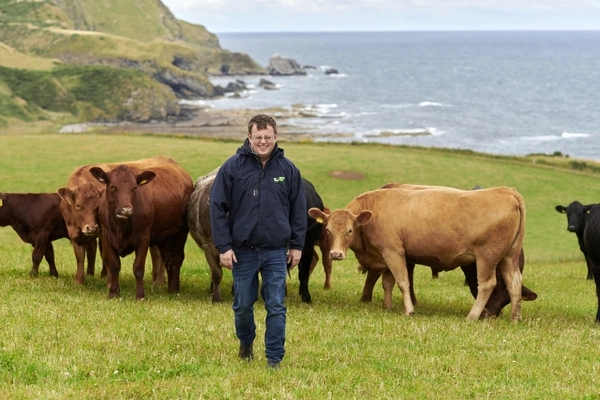
Suckler cows at the Banff and Buchan Monitor Farm are trialling new electronic rumen bolus technology, hoping to give farmer Bruce Irvine more breeding, health and welfare information to better manage his herd.
The use of electronic boluses in the rumen in dairy cattle is well established, using movement and temperature sensors to measure rumination, body temperature and activity. For dairy farmers, data analysis, through apps, provides early detection and recording of
bulling, calving, feeding issues and onset of illness. However, they are not currently widely used for sucklers.
Bruce is among the first beef producers to trial the system, putting rumen boluses into 100 of his summer-calving Stabilisers. The two-year ‘proof of concept’ trial supported by Scottish Government Innovation Project funding, involves vets, a nutritionist and bolus supplier smaXtec, and is examining the efficacy, accuracy and cost-benefits of boluses. Bruce hopes the technology will offer improved detection of bulling, cattle illness and calving management.
So far, the boluses have generated plenty of information, which is available to Bruce via an app. It highlights cows with temperatures above their average who may be developing an infection; measures rumen pulses so tracking rumination; works out how much water cows have drunk (via her drop in temperature from drinking cold water and an algorithm); tracks her movement and whether she’s in heat or has been bulled.
However, the system is currently calibrated for dairy cows, meaning there is some work to be done to make it accurate enough for sucklers whose daily life and eating patterns outdoors are more varied. Bruce and Ewan Jamieson, director at Meadows Vets, are working closely with smaXtec to address this.
Bruce says: “For the rumen pulses, the system expects cows to have 450-650 pulsations per minute, and when that drops, it’s usually a sign for dairy cows that they’re not getting enough forage or that the ration has changed. But our sucklers are not always eating the same ration – they might be eating grass or from a ring feeder, so rumen pulses in sucklers can be different to dairy cows who are eating the same all the time. The lowest we have had is 300 per minute which has resulted in an alert.”
He adds: “We’ve also had some challenges with the signal between the boluses and base stations which pick up the data. It would be no problem in a shed or in a flat field, but we have lots of undulations, which makes it difficult for the base stations to always be in contact with the boluses. We’ve had to move them a few times and buy another one to have enough coverage.
“If the cows are out of range, the boluses will store five days of data, but if there are 30-40 cows out of range, we have found it will take five to six days to ‘catch up’. Two of the base stations are solar powered, the other is run off a 12V car battery which lasts only five to six days on average, so we are planning to make that solar too.”
The boluses cost £30 each and are guaranteed for the life of the cow, with an expected battery life of five years, while the software/app subscription is £30/head/year. Bruce is hopeful that the value will come when the bolus identifies cows in heat and their service date. “I am trying to catch insemination dates so we can see how this works for the next calving cycle.”
He would like the bolus to accurately highlight when a cow is calving – and when they might be stuck – as they are in sheltered fields which are a distance from the farm and are currently checked four (or more) times each day.
“I hope it will all go in the right direction. SmaXtec is using the data and algorithms to make the system work better for sucklers. The app is good, and I often look at it – I could spend all day looking at the data if I wanted to. I know now that most of our cows drink once a day and usually about 28 litres or so, but the young bull that is carrying a bolus consistently drinks four times a day and drinks about 69 litres.”
Vet Ewan Jamieson will be providing an independent assessment of the benefits of boluses
and software on Bruce’s farm, and a cost-benefit analysis will also be done at the end of the project.
Helen Hollingsworth, who is part of the customer success team at smaXtec UK, says: “We wanted to take part in this trial to see the challenges presented by monitoring cows outside, be that dairy or beef. There are definitely more challenges with outside monitoring, where the topography of the land varies, and cows can potentially spend time ‘out of range’.
“With a range of up to 300m line of sight, it does mean farmers needs to consider how they can encourage cows to come closer to the base station at least once a day, be that with ring feeders, mineral licks or simply smaller fields, or they can use more base stations in order to cover larger areas.
“It’s easy to see on the app whether cows are behind on data or offline, which means they can then change the location of the base station. Having the base station powered by battery and solar means they can be mobile, using a trailer or similar, and taking the unit to where cows spend most of their time.
“As with any technology, customer input is vital, and Bruce has been very good at working with us and the system to get the most out of using smaXtec on his farm. We have already helped detect issues around calving time, while identify issues with feeding and heat detection has been working well too. We are excited to see how things progress.”
Monitor Farm regional adviser Peter Beattie says: “ The Monitor Farm Programme offers a unique opportunity to explore occurrences in real time. This technology could give suckler producers much more information about their cows and identify potential issues earlier. It’s an ongoing trial on a commercial scale and will be very interesting to see how it performs. Sharing experiences and learning together is at the heart of the programme”
Key areas for the trial:
• Herd fertility – ensuring compliance with requirements for the Scottish Suckler Beef Support Scheme, which now requires tight calving intervals. Ideally, boluses will identify bulling behaviour and where cows do not ‘take’ to the bull. Bulling behaviour is associated with increased activity from the cow; the project will show whether this is accurately measured and displayed in real time by the bolus technology.
• Cow health – vital for its own welfare, for its fertility, efficiency and ability to raise a calf. Cattle frequently show few signs of infection at an early stage, succumbing only at a point where farmer and vet intervention is required. The project will test if early detection of body temperature rise and changed behaviour can be detected by the bolus to provide alerts and early intervention.
• Calving success – a busy time on farm, the project will test whether a bolus can detect the
onset of birth, along with length of time in labour. Will early detection of calving help Bruce to better manage labour and prioritise attention to cows which may require assistance with calving?
About the Banff and Buchan Monitor Farm
Sauchentree Farm, at New Aberdour, on the north-east coast of Scotland, is run by Bruce Irvine in partnership with his wife Vicky and his mother. Help at lambing comes from art-lecturer Vicky, his sister and brother-in-law, and their two daughters are starting to get involved in the farm. A new chicken unit installed this summer has provided extra labour for the business.
In total, Bruce farms 263ha (650ac) with cereals, sheep and cattle. He believes the three enterprises are as important as each other, with livestock providing fertility for the arable side. Bruce markets their lamb and beef through Woodhead Bros, Turriff and ANM at Thainstone and enjoys competing with neighbouring farms on yield and lambing percentage. The family have been at Sauchentree for more than 200 years.