

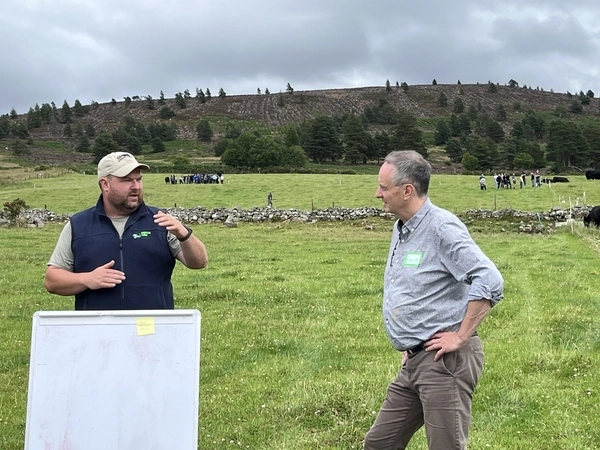
With recent positivity in the beef market and an industry call to keep more cows to maintain Scottish red meat production, suckler producers at the recent Deeside Monitor Farm open meeting discussed options to increase herd size and productivity.
Deeside Monitor Farmers Duncan and Claire Morrison from Meikle Maldron at Torphins near Banchory have recently been successful in obtaining a secure tenancy on a neighbouring unit. The additional 164 acres takes their total area farmed to 770 acres, mainly grassland, across four farms, with 110 acres owned, 430 acres tenanted and the rest seasonal lets. About 260 cows and heifers will be bulled this summer, consisting of pure Aberdeen Angus and Stabilisers plus a commercial herd; now they want to increase cow numbers to 320.
Speaking at the meeting, SAC Consulting senior beef specialist Gavin Hill said that while cow numbers in Scotland had dropped by 11.7% from 2015 to 2024 (a loss of 51,000 cows), some farms have increased cow numbers. Recent cattle prices have been encouraging but confidence is still needed. Economic pressure still dictates decisions, he said.
Now, 56% of Scotland’s suckler cows are kept on only 16% of holdings, with some suckler herds working with 600-900 breeding cows. “With larger breeding numbers, the aim is to spread their overheads over more cows to lower costs per head,” he said.
“In times of challenge there is innovation and adoption of ways to reducing costs. Some farms have worked to better use the scale and scope of the land they farm, such as outwintering on hill and upland areas, using collars to access areas they previously couldn’t graze and outwintering on hard hill areas with additional forage.”
He added that technical improvement will always be an aim, particularly suckler fertility, where numbers reared for every 100 cows put to the bull is still only about 86%. “That is a loss of a potential 14 calves in every 100 cows. However, although we may not have improved calving percentage, it has to be noted that bulling periods are far shorter than some years back.
“Another area to focus on is the use of data – if we are to maximise returns then more monitoring of performance is still needed. It is still concerning how many store cattle are going through the market at a very low weight for their age.”
Leading a discussion about how the Morrisons could increase cow numbers by 60, he said it was important to consider where those replacements should come from.
The future should be in youthful cows, so the focus should be on heifer replacements, he said. However, they need to fit into the Morrisons’ ethos. They breed for maternal traits and have a short bulling period of six to seven weeks, so current selected replacements are similar ages, come from the most fertile females in the herd, must achieve more than 1kg DLWG and have a good pelvic score. Gavin warned that buying replacements from out with the herd comes at a large capital and potential health cost.
However, cattle vet Tim Geraghty explained that increasing herd size quickly using only home-bred heifers could be challenging on top of maintaining replacement rates for older cows. “Herd expansion puts pressure on selection – a farmer may need to hold back heifers for replacements that are sub optimal, and the choice between retaining the best heifers versus selling these for the most money is a cash flow pressure known to all farmers!”
He discussed the pros and cons of two other potential options for the Morrisons; buying in heifers to allow rapid expansion, but with cash implications and health risks, or using AI and sexed semen to increase homebred females available for selection. Using sexed semen is a realistic option now Duncan has completed an AI course, and so both synchronized fixed time programmes, or using AI to naturally observed heats, could be used.
Also speaking at the meeting, breeder Neil McGowan from Incheoch Farm in Glenisla described ‘The Ultimate Cow’. She had to be fertile and able to calve at two years old and again at three, which could often be a challenge as the heifer is still growing while rearing a first calf.
“She needs to be producing calves regularly, ideally at around 365 days, to calve without assistance and to be fun to be around, so a good temperament, with good feet, good teats and udder.
“Recording these cow performance indicators and selecting from them is critical. In addition, the ultimate cow needs to fit into the environment of the farm, be low management – so in the case of the Morrisons, a cow that calves easily, keeps condition through winter and thrives in a low input system – and deliver what the market demands.”
Monitor Farm regional adviser Peter Beattie added: “I was delighted to hear so much positivity about growing suckler herds from the Morrisons, the speakers and attendees at the meeting. It was a practical, productive meeting, full of optimism and discussion.”