

Virtual fencing project’s summer of progress on Monitor Farms
Four of Scotland’s Monitor Farms are trialling an innovative virtual fencing system on their hill and upland grazing and are already seeing environmental and cattle management benefits, but some challenges have been identified.
The four Monitor Farms involved – Argyllshire, South Ayrshire, Stirlingshire and Strathspey – have 25 collars apiece from Norwegian specialist Monil and are testing them in their herds to assess the cost-benefit in a two-year project.
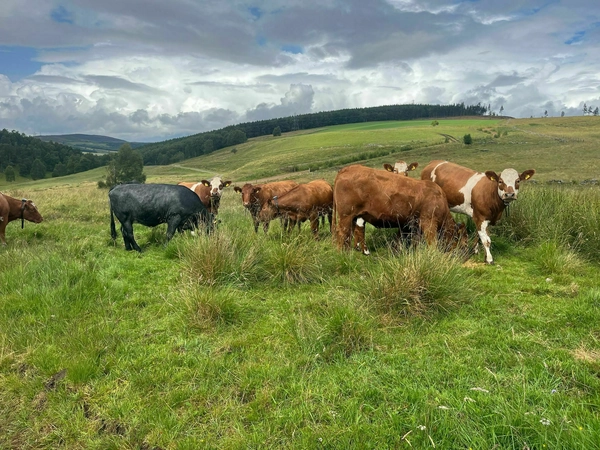
The farms have all run cattle at grass this summer and have managed their grazing areas using the collars and the associated app. Initially, they started the project by fitting the solar-powered collars, training their cattle to turn away when they hear the collar’s signal for the virtual fence, and then turned their cows out on upland and hill grazing. The virtual fence is set using the app, where the fence, individual animal location and movement, plus any escapees, are seen. The virtual fences can be moved and any breakouts managed remotely via the app, with notifications sent when cattle don’t move for a certain period.
On the South Ayrshire Monitor Farm, David Andrew has been busy calving his collar-wearing heifers, who have now moved off the main hill grazing to in-bye land.
“Having the collars means we can find them very easily when it could have taken us hours in the past if we were looking for a missing cow in bracken or on a foggy day with little visibility on the hill, especially if an animal had gone away from the main herd to calve, which often happens. Now it takes us 15 minutes to find and check the cattle, but took us up to an hour before, and I now wonder how we did it before this technology!”
Their in-bye land also has an area which has been reseeded with a kale and stubble turnip mix, and the virtual fencing has been used to successfully exclude cows from this area, he says. When they were on the hill, the virtual fencing meant they grazed areas they would not normally visit. “When it came to gathering the sheep, I don’t think I’ve ever gathered more ewes off that side of the hill – you can see the good the cattle grazing has done.”
At the Strathspey Monitor Farm, brothers Calum and Hamish Smith are also positive, though they have had a few breakouts in recent weeks, something they put down to some disturbance from other groups of cattle. “We also had two heifers whose collars came off, and it was two or three weeks before we could put them back on. We can see those animals were excessively testing the virtual fencing boundaries after that.” The heifers have grown since the collars were first put on, so a few have also needed adjusting.
The Smiths have used virtual fencing to manage their hill land much more effectively and are now able to graze areas with poor physical fencing. They have been rotating heifers round three large ‘virtual paddocks’ and have found moving them in the evenings when they are settled has worked well. “The cattle and the hill look well,” says Calum. They hope to keep the heifers out for longer this autumn as a consequence and may then put the collars onto cows who overwinter outside.
For the Stirlingshire Monitor Farm, the trial has been more challenging, with connectivity issues meaning they have not been able to make full use of the technology at their Inveruglas hill unit. Rebecca Duncan says: “We have ended up using the collars more like trackers, but the signal is very patchy. We have had one animal who got ‘stuck’ inside the virtual fence and another group of four who split from the rest too.” Work to address the connectivity issue is continuing with the collar and technology supplier Monil.
Connectivity has also been an issue at times on the Argyll Monitor Farm on Islay, says farmer Craig Archibald. “Closer to home it has worked better, but certain pastures have been difficult, especially where the cattle have gone into the shadows of the hills. It also means it takes quite a time to update.”
However, he says that the system has mostly worked well, and animals have grazed down a lot of the farm’s rougher, longer grass, especially Molinia. He is also grazing sheep alongside the cattle, and being able to keep the gates open has made gathering sheep much easier.
Grass on the farm was analysed this summer, with a little supplementary feeding given in this first year to compensate for the lower nutritional value of the hill grass. However, grass quality is already improving with grazing this year and will be analysed again next summer; it’s thought that in future little to no supplementary feeding will be required.
The cattle have recently been body condition scored, and have maintained their condition, so will be outwintered, calving outside next spring. They are usually housed in winter, but better use of grass means there’s an option for outwintering, freeing up indoor space and allowing Craig to bring in other cattle for winter feeding. Outwintering cattle will also test the collars’ solar power capability, which has not yet been an issue on-farm.
Providing an update on progress, Monitor Farm regional adviser Christine Cuthbertson says: “It has been really interesting to see how the different farms have found using the collars. The connectivity issues have been a challenge, especially for the Stirlingshire Monitor Farm, but we hope this will be resolved shortly. I am looking forward to seeing how results look this autumn and how the farms might be able to change their approach using virtual fencing.”
Further information:
The Monitor Farms and their virtual fencing goals:
Argyll
– the Archibald family are trialling with 25 of the farm’s 225 Aberdeen Angus cows on hill land at Craigens Farm. Their goals are:
South Ayrshire – John and David Andrew are trialling on 25 of the farm’s 150 breeding cattle at their Blair hill farm. Their goals are:
Stirlingshire
– the Duncan family, trialling with 25 native-bred hill cows at Lands of Drumhead and Inveruglas. Their key goals:
Strathspey
– the Smiths at Auchernack are trialling the technology with 13 Shorthorn x Limousin bulling heifers on a hill which requires targeted grazing for biodiversity and also on 11 heifers in-bye, potentially on species-rich grassland (an important, but undergrazed Strathspey habitat). They may put one collar on the bull with the heifers. Their goals are:
Find out more about the Virtual Fencing project on the Monitor Farm Scotland YouTube page: https://www.youtube.com/watch?v=ddTFXNX6H0w (introduction to the project) plus watch individual updates from the four farms involved.