

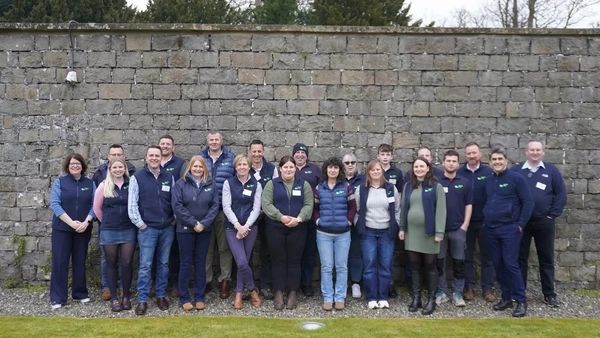
It seems like no time since the current Monitor Farm Scotland programme launched at AgriScot in November 2022. Since then, the nine Monitor Farm businesses have been involved in many projects, trials and on-farm meetings, all aimed at improving the productivity, profitability, and sustainability of their businesses.
With the programme being ‘farmer-led, farmer-driven’, each farm’s management group and meeting attendees have been able to suggest and steer meeting topics, as well as encouraging each Monitor Farm to try new and different approaches.
It’s the first Monitor Farm programme to run over four years, with the extra year allowing more time for developing and testing ideas and assessing practical outcomes. So what have the nine Monitor Farmers got planned for 2026, their fourth and final year?
Argyllshire – Craig Archibald, Craigens Farm, Islay; sucklers, store production, ewes and finishing lambs, plus spring barley for local distillery.
Being involved in the virtual fencing project has been a great benefit over summer, but lack of connectivity in autumn meant the 20 trial cows are now housed rather than outwintering. However, with ongoing work to solve technical issues, the second year of virtual fencing will see cows calve outside on extensive sand dunes – something now possible because Craig can create ‘virtual fields’ and find cows who have gone off to calve.
Investigations to find the best suckler cow for the farm will continue. With plenty of data, Craig will also be selecting those who have the traits to do well in virtual fencing to expand the project.
The new Mule flock – a Monitor Farm-driven change – will be assessed for performance, hoping for better productivity, growth and early finishing.
Soil health will also come into focus next year, especially compaction caused by geese, while the benefits of adopting rotational grazing will also become clearer.
Banff and Buchan – Bruce Irvine, Sauchentree, Fraserburgh; suckler cows and breeding ewes, taking progeny through to finishing, arable, plus new hen unit.
Next year is a big one for the Irvine family: “It will be 250 years of our family farming at Sauchentree – my daughters are the tenth generation.”
Monitor Farm-wise, he will be looking at better use of grass, splitting fields to further develop paddock grazing. “We also need to find a better risk management approach for forage crops, as I planted 30 acres of swedes this year and nothing grew.” Being near the coast, the farm is on shallow, sandy soils which are drought-prone.
Deciding on EID systems for cattle is another focus. Bruce is currently involved in trialling electronic boluses in his sucklers, hoping they could highlight events such as calving to help reduce workload.
Changing from organic to conventional two years ago, he wants to improve arable profitability which has dropped since conversion. Another focus is best use of muck from the 32,000 laying hens now on-farm.
Deeside – Duncan and Claire Morrison, Meikle Maldron, Banchory; commercial and pedigree sucklers, offspring sold as store, finished or breeding stock, plus sheep.
Duncan and Claire expanded their farm business this year, obtaining a tenancy on a neighbouring 160-acre farm. Happy with their technical performance and the system they have in place, this year has seen the Monitor Farm and management group concentrate on learning more about business aspects.
This has included sessions on using accounting package Xero on farm, hearing from a banker about what they look for in a business seeking a loan, and financial planning for the future. “They’ve been really interactive sessions with the whole management group, and for next year, I’m asking that group what they would like to do.”
Duncan says one of the things he enjoys most with Monitor Farms is being able to visit other businesses and to discuss what they are doing. “You can hear about what people are doing, but never really grasp it until you see it with your own eyes – it gets you thinking.”
Dumfriesshire – Richard McCornick, Barnbackle, Dumfries; commercial and pedigree sucklers, selling as stores and for breeding, breeding ewes with lambs sold off grass.
Last year’s work using EBVs for selecting a new bull for breeding replacements will see his first crop of calves arrive at Barnbackle, while Richard also plans to start using sexed semen to breed replacements from his best performing commercial cows. As part of this, all his cattle now carry TruTest electronic tags which highlight heats and other health traits.
The sheep have been split into A and B flocks, depending upon performance, and Richard will also start to see the results of not breeding from his ewe lambs but waiting a year longer. “I think we will see them produce more, bigger lambs than if they were bred as ewe lambs. They should also get back in lamb more easily.”
The rotational grazing project at Barnbackle will progress further, and he’s looking at different establishment methods for kale and swede winter forage crops, with discing and using the fertiliser spreader looking successful.
East Lothian – Stuart McNicol, Castleton, North Berwick; arable, with cover crops grazed by sheep over winter plus agri-tourism businesses.
Stuart had a very successful harvest, with all crops yielding well. His spring barley made malting grade, but with poor prices, the area grown will be reduced in 2026. Instead, he will rent the land to a local grower for growing sprouts and cabbage.
He has been trialling cover crops for the last couple of years, but the dry summer and autumn has impacted growth this year. However, the three mixes – one farm saved and the other two being commercially available grazing mixes – are currently being grazed by Hebridean sheep.
With a brome issue, he has been doing more ploughing in addition to chemical control. This is a change to his usual min-till approach, but essential for weed control.
“I’d set out on the Monitor Farm programme to tackle net zero, but we haven’t done that – and neither has anyone else. We’ve also been trying to reduce costs, but that is hard on this size of farm.
Roxburghshire – Robert Wilson, Cowbog, Kelso; purebred sucklers with offspring sold for breeding or finished, sheep and arable.
There has been lots of change at Cowbog, not least the end of a tenancy which has now become a contract farming agreement, with a proportion of the arable land converting to temporary grass leading to an overall reduction in arable in the business, allowing Robert to run cattle more extensively.
Calving period has been tightened, increasing the spring herd and stopping the autumn calvers. Doing this while trying not to lose production has been ‘slightly like turning round an oil tanker,’ he says.
Cow numbers are growing, and with a feeling that they only needed a maximum of 100 pure Hereford calves, an Aberdeen Angus bull is now being used on 20% of cows; the farm’s first ‘Black Baldie’ calves are due in spring. “That change of sire comes with an opportunity to reevaluate our marketing of stock,” says Robert.
With the increase in cow numbers, he will be looking at what’s best – increasing numbers or maintaining some extensiveness, while escalating winter silage costs will be scrutinised.
South Ayrshire – John and David Andrew, Rowanston, Maybole; sucklers, with progeny and bought-in stores finished, breeding ewes and arable.
A project looking at finishing cattle performance and costs will be a big focus for 2026 for the Andrews. It is following home-bred and bought-in stores who will finish from February onwards. “It will be interesting to see how the different batches and breeds compare,” says David.
They are also going to be trialling finishing bull beef; autumn-born terminal-sired calves will be finished indoors over summer, taking pressure off summer grazing.
They are one of the four farms involved in the virtual fencing project and are keen to see how much more they can achieve with it in 2026. “It would be a thought to go back to not having it now,” he adds.
Having fully set up their rotational grazing system, they plan to make more of it next year, having ‘learned from their mistakes’.
“Overall, we are making tweaks and changes, trying to get the most out of every enterprise,” says David.
Stirlingshire – the Duncan family, Lands of Drumhead and Blairfad; breeding sheep, with stratified system on hill and lowland, plus suckler cows, selling stores.
Grass productivity is a key focus for the Duncans, with a liming and reseeding programme started since becoming a Monitor Farm; they were unaware soil pH levels across the farm were so low. Next year will see more livestock performance results analysed; the family says better grass quality meant they sold more lambs fat this year.
They have also changed sheep breeds, with a new Cheviot flock which they have enjoyed working with and plan to expand.
Their sucklers have been part of the virtual fencing trial, but connectivity issues have meant it has been of limited use this year. With this issue almost solved, they hope to make progress in 2026.
A new cattle handling system – suggested by Monitor Farm visitors – has made weighing much easier, with plenty of data now to assess. They are planning to use the data, alongside much more enterprise-specific costings, to focus on productivity and profitability of each enterprise.
Strathspey – the Smith family, Auchernack, Grantown-on-Spey; commercial suckler cows, selling progeny as stores.
The Smith family are in the middle of a succession transition, with father, Malcolm, now working full-time off the farm and his sons Calum and Hamish full-time on the farm. Next year will see this progress further, with both sons growing their involvement and their contracting business.
The brothers have opted to use a Shorthorn bull on their cows in a change from a Limousin, and have recently bought a second Shorthorn, believing a native breed will suit their system better. Calum says: “We will be pushing forward with the Shorthorns in 2026.”
Being part of the Monitor Farm virtual fencing trial has been a highlight at Auchernack, bringing production and environmental benefits. The family are looking forward to seeing how they can adapt its use and what they can achieve with it in 2026 having had a year’s experience. “This year the grazing set up was a massive boost.”
More on Monitor Farm Scotland
Find out more about each of the Monitor Farms, read meeting reports and see trial results and project updates, as well as finding information about previous Monitor Farm programmes at https://www.monitorfarms.co.uk/. The website also hosts details of upcoming meetings and how to book your space.