

Action
needed to maintain wormer efficacy as resistance rises in flocks
Sheep producers are being urged to plan their worming strategy
and carry out faecal egg counts as the issue of resistance to wormers becomes
more common and increasingly serious.
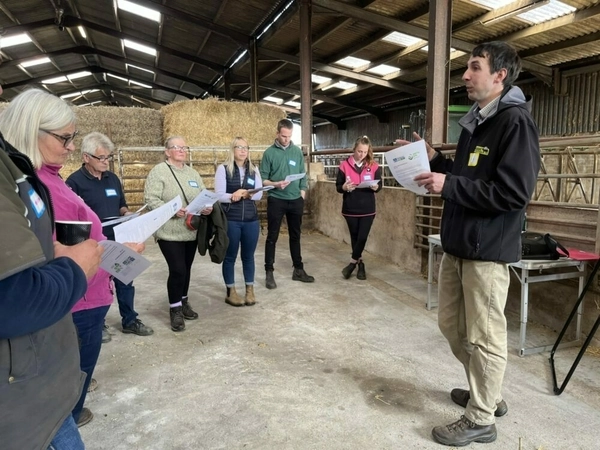
Speaking at the recent sheep special Banff and Buchan Monitor Farm meeting,
vet Ewan Jamieson, director of Meadows Vet Centre, said testing on farms in
Aberdeenshire had shown the issue of worm resistance to wormer was increasing.
A trial across nine farms found that worm control after one drench was as low
as 12% on one farm. “It just wasn’t working,” he said.
“Really, every time you use a wormer you are contributing to
resistance developing, no matter how well you use them,” he warned.
“People have been talking about this problem for years, and we
were seeing issues anecdotally, so we decided to do an on-farm trial in
Aberdeenshire looking at wormer efficacy. The trial has opened our eyes to how
bad the problem could be.”
It involved collecting fresh dung from five lambs on each farm
at the time of initial dosing, with Ewan using the practice’s AI-powered kit to
produce quick and accurate faecal worm egg count (FWEC) results. Samples were
then taken from the same five lambs either a week after worming (yellow
drenches) or two weeks later (white and clear drenches). “We could then compare
the results before and after worming and calculate a percentage efficacy.”
Farms which were alternating between all three drenches achieved
consistently good results, but efficacy across all farms varied from 12% to
100%, he said.
He
says that where there are serious problems with resistance, it may force
producers to rotate between two products rather than three (clear, yellow and
white drenches). This in turn speeds up development of resistance to the
remaining products. Where people are under-dosing or choosing to repeatedly use
one product, eg a clear drench which is long-acting, this will increase the
risk of resistance to that product.
“Also,
ensure you practice the dose, wait, move approach. Think about your quarantine
dose when you buy-in lambs or replacement ewes and make use of an end-of-year
knock-out drench which should be based on the two new orange and purple classes
of wormer.
He
advises carrying out FWEC to assess worm burdens and worming accordingly. “I do
understand why people don’t do FWEC, as it does take some planning and time.
But we now have some farms struggling to control worms – in some areas, the
issue has forced some farms to give up sheep altogether.
“I’d
rather people didn’t have to use as much wormer. Besides FWEC, there are other
management practices which will help reduce their use,” he said. Adopting
management practices such as putting ewes and lambs
onto new grass (reseeds), brassica or root crops or herbal leys including
chicory, birdsfoot trefoil and sainfoin, all provide clean grazing. Grazing
with cattle or older sheep would also help clean up pasture, as would cutting
for hay or silage.
This year, Ewan worked with Monitor Farmer Bruce Irvine on a
worming strategy for the farm’s 700 lambs based on FWEC results. Grazing
pasture was risk-assessed according to the age of
ley, grazing history and ongoing assessment according to weather.
Fresh dung samples were collected from pasture for FWEC, and
lambs then wormed in early May with a white wormer. Dry weather kept burdens
low, but nematodirus cases were then starting to be seen on Aberdeenshire
farms. “There’s no preventative treatment for nematodirus, so treatment timing
is critical.”
All lambs were treated at weaning in late July with yellow drench. Even though one of the two groups had a low FWEC, all
were treated as they were being mixed at weaning which had management
implications, said Ewan.
He added that the very dry weather initially helped to keep worm
burdens down, but as grass growth slowed, fields were being grazed down to the
soil and worm burdens were able to rise quicker into August.
“Dry weather this summer also seems to have reduced mineral
levels in the grass. Cobalt, in particular, has impacts on gut health and so
low cobalt may be contributing on some farms to higher worm burdens. Bruce’s
lambs were treated with Smart-Shot B12 at weaning, but boluses or mineral
drenches could also have been used,” he said.
About the Banff and Buchan Monitor Farm
Sauchentree Farm, at New Aberdour, on the north-east coast of
Scotland, is run by Bruce Irvine in partnership with his wife Vicky and his
mother. Help at lambing comes from art-lecturer Vicky, his sister and
brother-in-law, and their two daughters are starting to get involved in the
farm. A new chicken unit installed this summer has provided extra labour for
the business.
In total, Bruce farms 263ha (650ac) with cereals, sheep and
cattle. He believes the three enterprises are as important as each other, with
livestock providing fertility for the arable side. Bruce markets their lamb and
beef through Woodhead Bros, Turriff and ANM at Thainstone and enjoys competing
with neighbouring farms on yield and lambing percentage. The family have been
at Sauchentree for more than 200 years.