
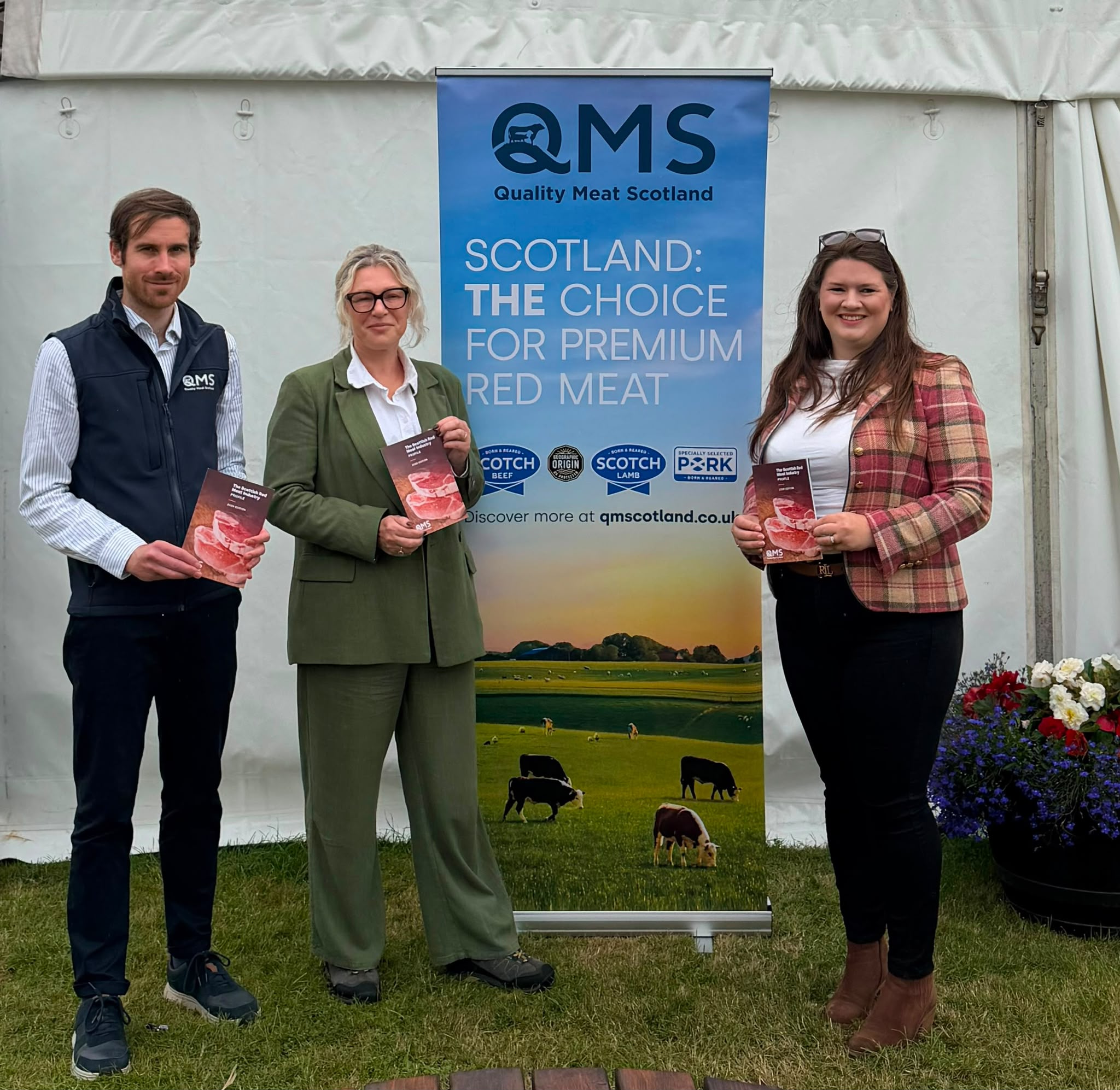
Quality Meat Scotland’s (QMS) latest Red Meat Industry Profile shows farming, processing and the associated supply chains combined is now worth over £4.2 billion of output and £1.3 billion of GVA in 2025 – its highest level ever recorded.
The report – a key statistical tool supporting Scotland’s red meat and business decision makers – underlines the continued resilience and socio-economic importance of Scottish beef, lamb and pork, with the sector sustaining around 40,000 jobs across the supply chain.
Combined economic impact rose by 18.5% in 2025, driven by higher cattle and sheep prices – prime cattle prices averaged approximately £6.60 per kg deadweight in 2025, up 30.3% year-on-year. The value of cattle, sheep and pig farming increased by 17.6% to £1.9 billion, while primary processing rose by 20.2% to £1.36 billion.
While higher farmgate prices supported store producer confidence and underlying consumer demand for foods naturally high in protein remained strong, a 30% increase in the retail price of beef has led to some changes in purchasing patterns, with some shoppers shifting towards cheaper cuts and alternative proteins.
QMS Chief Executive Sarah Millar said: “These figures underline the scale, strength and continued importance of Scotland’s red meat sector. At £4.2 billion of output and £1.3 billion of GVA; beef, lamb and pork are delivering major economic value for Scotland and supporting jobs, businesses and communities across the country including in some of our most remote and rural communities.
“Whilst consumers have demonstrated that they continue to value red meat produced in Scotland and the market remains resilient, purchase volumes have reduced as higher prices influence buying behaviour. This, alongside declining livestock numbers, import competition and the severe pressure facing Scotland’s pig producers mean that we must continue to ensure focus is on how this sector can be supported to protect future growth, food security and rural livelihoods.”
Sheep sector strengthens on record prices, export growth and flock recovery
The sheep sector has had another strong year following record producer prices, export growth and signs of flock recovery. Average Scottish prime sheep prices reached a new historical high of £3.28 per kg liveweight, rising 52.1% over the past five years.
An improved lambing rate and rebound in abattoir production in Scotland also contributed to longer term optimism, with stronger market signals helping to rebuild confidence after three years of decline in the ewe flock.
Livestock decline remains a longer-term risk
Despite the stronger economic figures, QMS warned that the reduction in Scotland’s beef cow and pig herds presents a longer-term risk to the sector’s economic and social contribution.
The pace of decline in Scotland’s beef cow herd slowed to 1.4% year-on-year in December 2024, but numbers remained 10.4% below 2021 levels. Meanwhile, the continued net outflow of store and finished livestock limited Scotland’s ability to capture the full economic value of its production, although the outflow of store cattle to finishers in England and Wales slowed further from the peak seen in 2022.
The Meating Our Potential campaign, led by QMS in partnership with the Scottish Red Meat Resilience Group, is working to reverse declining livestock numbers and realise an estimated growth opportunity of around £350 million of output and £100 million of GVA by 2032 across Scotland’s red meat sector.
In 2025, the campaign secured pledges from the UK and Scottish Governments alongside around 30 key agri-food organisations to “feed our growing nation with locally produced, sustainable red meat”, reached more than five million people in Scotland, and was supported by the Scottish Government’s public rejection of Climate Change Committee advice to reduce livestock numbers.
Rural Affairs Cabinet Secretary Gillian Martin said: “Quality Meat Scotland’s latest Red Meat Industry Profile underlines the vital contribution our red meat sector makes to the economy and rural communities, with the value of the supply chain now worth more than ever.
“This is testament to the hard work of all involved, starting with production on farm, all the way through the supply chain.
“I recently announced funding to support the pig sector. It is important farmers have the confidence to invest, so consumers can continue to access the quality Scottish produce they know and love. We will continue to work closely with industry partners to support a resilient, sustainable and prosperous future for Scotland’s red meat sector.”
Import competition sharpens food security challenge
QMS said a growing UK population, firm demand for red meat and declining domestic livestock production mean UK consumers will be more reliant on imports if domestic production is not strengthened.
The report highlights a significant level of switching away from domestic products towards highly competitively priced beef from non-EU sources in the hospitality sector, with non-EU beef rising from around 10% of UK imports to around 25-30% in the second half of the year. Increased imports of specific higher value cuts can have an even more destabilising effect on the domestic market than suggested by the volume of meat alone, affecting carcase balance. For example, the imported volume of striploins from 22 cattle is equivalent to the weight of just a single domestic carcase.
The trend underlines the importance of strengthening domestic production in a geopolitically volatile environment, where food security, high production standards and supply chain resilience are increasingly critical.
Pressures intensify on the pig sector
Pressure continued to build on the pig sector in the second half of 2025. A growing backlog on farm contributed to falling farmgate prices along with an external shock due to low EU pig and pork prices. EU pig prices fell sharply in the second half of 2025 due to increased production, higher tariffs on EU pork in China and an African Swine Fever (ASF) outbreak in Spain which left the EU’s largest pork producer unable to export to some of its main destinations.
The domestic backlog resulted in more carcases exceeding target weight ranges, lowering prices and pushing up production costs. Meanwhile, low EU pig and pork prices placed downwards pressure on values in price sensitive market segments, driving down prices across the supply chain.
Into 2026, the unsustainable market conditions have prevailed, with Scottish pig prices falling well below the cost of production. As a result, breeding sow slaughter rose by 34% in the first half of the year at Scottish abattoirs, equivalent to the loss of 12% of the breeding sows reported in the June 2025 census results. In response, the Scottish Government announced £2 million of direct support to independent Scottish pig producers hit hardest. QMS and key partners representing the Scottish pig industry continue to work closely with the Scottish Government to tackle the critical issue and address the longer-term underlying issues impacting profitability.
QMS Market Intelligence Manager Iain Macdonald said: “The 2025 data tells a powerful story of value, demand and opportunity, but also of pressure points that need urgent attention. Strong cattle and sheep prices have lifted the sector’s economic contribution, but they also reflect tight supply and the consequences of long-running structural challenges.
“The sheep sector’s performance is encouraging and shows what can be achieved when demand, trade opportunities, flock recovery and production momentum align. But the pig sector is under severe strain, and the beef herd remains smaller than Scotland needs it to be if we are to reduce import reliance and protect food security.
“Stabilising breeding numbers, continued productivity improvements, retaining more value in Scotland and restoring confidence across the supply chain are essential if we are to capture the growth opportunity ahead.”