
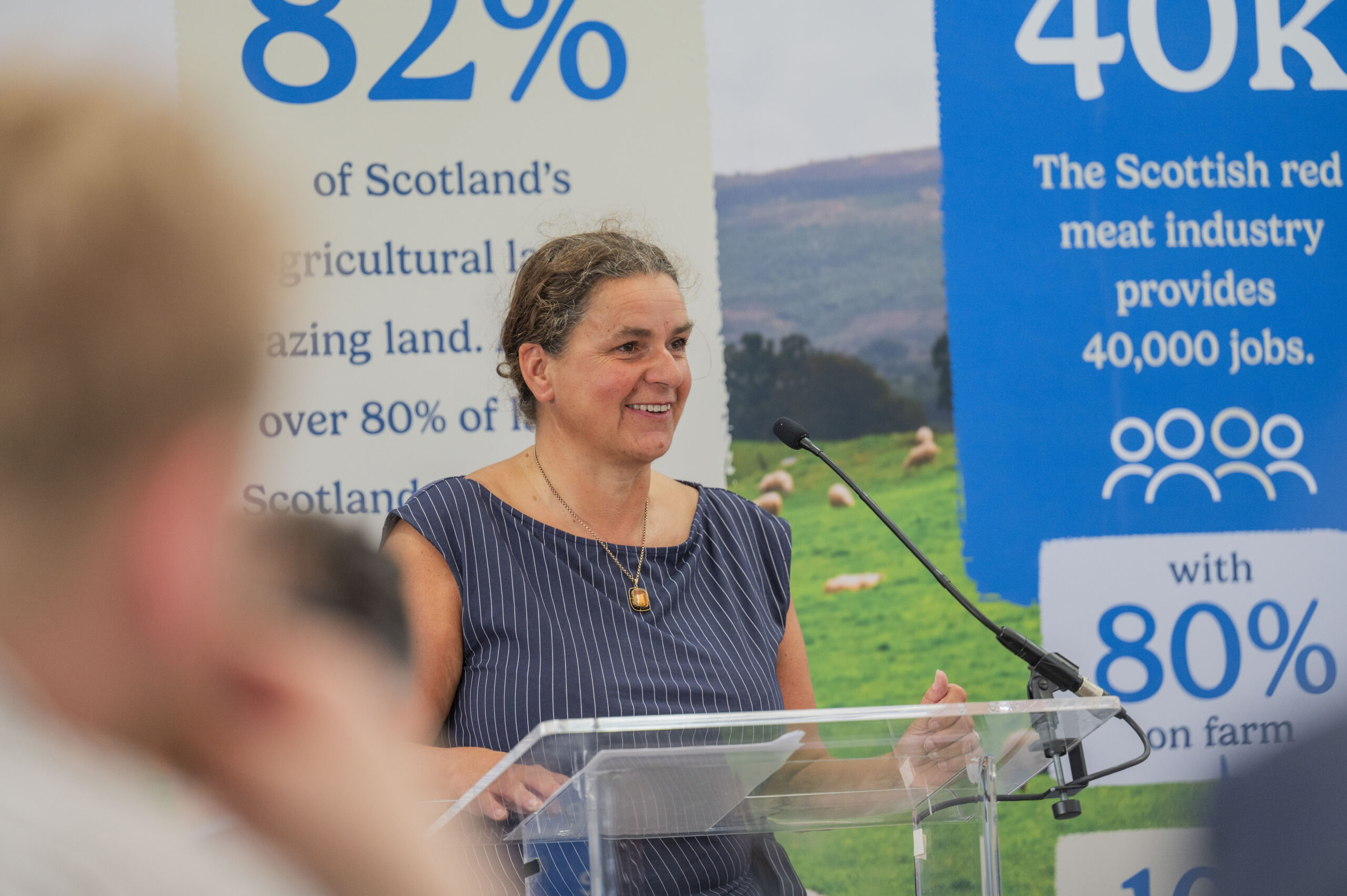
In her eighth and final year as Chair of Quality Meat Scotland (QMS), fifth-generation livestock farmer and red meat leader Kate Rowell reflects on the extraordinary change – political, economic, environmental and cultural – which has spanned her tenure:
“When I joined the QMS Board in 2015, I never imagined I would one day lead it. Fast forward from then to now, and we have been at the centre of some of the most turbulent and transformative moments in recent agricultural history. It has been both a personal and sector-wide journey of resilience and ambition.
“Scotland’s red meat sector has transformed and been tested over the past 12 years. We’ve been through Brexit and its long‑tail implications; a global and unprecedented pandemic; geopolitical instability, from Ukraine to the Middle East; shifting governments, ministers and policy landscapes; surging inflation and input costs; and the rise – and fall – of the plant‑based hype.
“Through it all, Scotland’s red meat supply chain has not only endured but adapted. Lamb and beef prices have reached historic highs – the year I became Chair; new season lamb prices had reached £3 per kilo for the first time; this year they peaked at £4.70kg. Beef back then was £3.80-90 per kilo and while down from the record highs of 2025, it’s still almost £6 today.
“Consumer attitudes have evolved – in 2018, veganism dominated headlines and plant‑based alternatives were heralded as the future. Today, the mood has shifted dramatically – people want to fuel their bodies with nutritious food such as healthy red meat protein.
“Marketing has evolved too. Where once there was hesitation about showing livestock and meat together, transparency is now a strength. Nowadays people want the reassurance of the high welfare standards as well as the whole-of-life traceability, which is behind the famous blue labels of Scotch Beef, Scotch Lamb and Prime Scottish Pork.
“Our highly successful ‘When You Know You Know’ consumer marketing campaign is rooted in the latest consumer insight. Red meat consumption has remained stable and consumer trust in Scotch brands has soared to 84%. A massive 88% also recognise Scotch Beef and Scotch Lamb, with 76% of consumers saying they will now seek out Scotch brands when they shop.
“Showcasing our brands on the global stage has also been central to our approach in making Scotland the choice for premium red meat. The Scotch brands have been championed from Japan to Denver to Brazil, and there’s been some valuable lessons learned along the way about global markets, consumer expectations and the competitive landscape. The impact is clear with exports reaching a record £173 million in 2024/25, representing a 26% increase on the previous year, with volume up 10%. These trips put us firmly on the map and reinforce a simple truth: Scotland punches far above its weight in the global red meat sector.
“The declaration of a climate emergency in 2019 reshaped the agricultural conversation. Rather than retreat from scrutiny, QMS leaned into science, leading UK‑wide environmental baselining work with AHDB and HCC to demonstrate livestock is part of the solution. Early findings suggest that current carbon accounting methods may significantly underestimate Scotland’s soil carbon stores — a potential game‑changer for how livestock farming is understood in climate policy. As the rest of the results continue to come through, we look forward to further understanding the strengths and opportunities of Scotland’s natural climate, landscape and farming systems to support Scottish farmers in sustainable food production for generations to come.
“The Scottish red meat sector is stronger, more valued and more future‑focused than many within it realise. This positive message resonates deeply with ongoing initiatives such as Meating Our Potential, the partnership campaign with the Scottish Red Meat Resilience Group designed to tackle declining livestock numbers and unlock long‑term economic growth.
“The economic opportunity is substantial with our latest forecast projecting a combined Scottish beef and sheep growth opportunity to 2032 worth around £350 million in output an around £100 million in GVA. This builds on a sector already worth £3.5 billion in output and supporting 47,000 jobs across Scotland. This is backed by consumers in Scotland having strong appetite for locally produced food and concerns about imported alternatives. New QMS-commissioned consumer research findings (Censuswide, May 2026) highlight eight out of 10 (81%) respondents in Scotland say they want their supermarkets to prioritise stocking Scottish red meat over imported alternatives, while seven out of 10 (71%) say they would be concerned if imported red meat became significantly more common on Scottish supermarket shelves.
“But the benefits extend far beyond economics. Livestock farming underpins biodiversity, wildfire prevention, flood mitigation, rural communities, national identity and food security. These contributions are almost incalculable and too often overlooked.
“In terms of giving the Scottish red meat sector confidence, the key highlight of my whole time at QMS was the Scottish Government’s public rejection of the Climate Change Committee’s recommendation to reduce livestock numbers — a decision shaped by extensive evidence and advocacy from QMS and industry partners.
“In my final year, my lasting message for the sector is simple but powerful: believe in what you do.
“Public trust is high. Local and global demand for premium, sustainable protein is rising. Scotland’s natural assets and farming systems are world‑class. And the sector has proven time and again that it can adapt, innovate and lead.
“The need for positive, rational thinking is not just personal advice — it’s a strategic imperative for the industry.
“Our sector is more confident, more united and more ambitious than the one when I first became QMS Chair in 2018 – the challenge now is to keep that momentum, to continue Meating Our Potential and ensure Scotland remains the global benchmark for premium red meat.”
Recruitment for QMS’ next Chair open until 11th August, for more information and to apply, visit: Appointment of Chair to the Board of Quality Meat Scotland – Scottish Government Recruitment Careers